
How to Make Your Lights Smart (Without Accidentally Building a Small Nightclub)
As an affiliate in various programs and Amazon Associate, Smart Home Labo earns from qualifying purchases. This site contains affiliate links.
When people begin exploring smart homes, lighting is often one of the first upgrades they consider. Not because smart bulbs are the most advanced devices available, and certainly not because replacing a light bulb sounds particularly exciting, but because lighting is one of the rare smart home improvements whose impact becomes visible almost immediately in everyday life.
A robot vacuum saves time. Smart energy monitoring may reduce electricity usage. Sensors quietly automate routines in the background.
Lighting behaves differently.
Lighting changes how a home feels.
The first time your bedroom gradually brightens in the morning instead of throwing cold white light directly into your eyes, or the first time your living room softly illuminates before you arrive home after work, there is often a small realization:
Maybe the goal of a smart home is not adding more technology everywhere. Maybe it is removing tiny inconveniences that became so normal you stopped noticing them years ago.
Before Thinking About Colors, Think About Comfort
Section titled “Before Thinking About Colors, Think About Comfort”One of the most common beginner mistakes with smart lighting is immediately focusing on RGB bulbs and colorful effects because, understandably, they are the products that look most impressive in advertisements, YouTube videos, and social media posts.
I understand the temptation.
A room glowing purple behind a television looks futuristic. Shelves illuminated with gradients feel expensive. Entertainment setups reacting dramatically to games create the impression of living several years in the future.
After years experimenting with smart homes though, if I had to rebuild everything from zero, I would spend my budget on tunable white lighting before buying anything RGB.
That recommendation sounds boring.
It is also probably the upgrade with the largest impact on daily comfort.
Tunable white bulbs can change color temperature throughout the day, shifting from cooler whites when concentration is useful toward warmer tones as evening approaches.
At first glance, this sounds like a relatively minor feature.
In practice, it changes how your home behaves around you.
Your Brain Has Been Using Adaptive Lighting Since Before Electricity Existed
Section titled “Your Brain Has Been Using Adaptive Lighting Since Before Electricity Existed”One thing that surprised me when learning more about lighting is how automatic our response to it really is.
Most people associate blue light with smartphones, tablets, or computer monitors. The largest source of blue light humans receive, however, has always been the same: the sun.
During the middle of the day, sunlight contains a relatively large amount of blue wavelengths. Your body continuously interprets that information without asking your permission.
Blue-rich light tells your brain:
Stay awake. Stay alert. It is daytime.
Then something subtle happens near sunset.
Light gradually becomes warmer, slightly orange, slightly reddish, and the amount of blue wavelengths decreases.
Your brain receives another message:
The day is ending. Start slowing down.
Nature has effectively been providing adaptive lighting for millions of years.
Then modern homes happened.
Now imagine waking up at two in the morning, walking half asleep toward the bathroom, and immediately turning on a ceiling light configured to bright cool white. You get blinded for a moment. Your body receives a strong signal:
Good morning. Apparently we are beginning the day now.
That strange feeling where you suddenly become more awake after turning on lights during the night is often not imagination.
Blue-rich lighting suppresses melatonin production, influences sleep readiness, and can make falling asleep again noticeably harder.
Your lighting, unintentionally, starts working against your biology.
Adaptive Lighting Became One of the Few Automations I Would Reinstall Immediately
Section titled “Adaptive Lighting Became One of the Few Automations I Would Reinstall Immediately”Because of this, adaptive lighting has become one of the rare smart home features I would probably reinstall within the first few days after moving (I actually did when I moved last year, and I am still cursing down lights that need an electrician to be replaced and have no option for white color temperature).
Adaptive lighting automatically changes brightness and color temperature throughout the day. Lights become cooler and brighter during periods where energy is useful, then gradually shift toward warmer and softer tones as evening progresses, before becoming dim enough at night that turning on a light no longer feels like opening a refrigerator inside your skull.
The interesting thing about adaptive lighting is that visitors rarely notice it.
You notice it when it disappears.
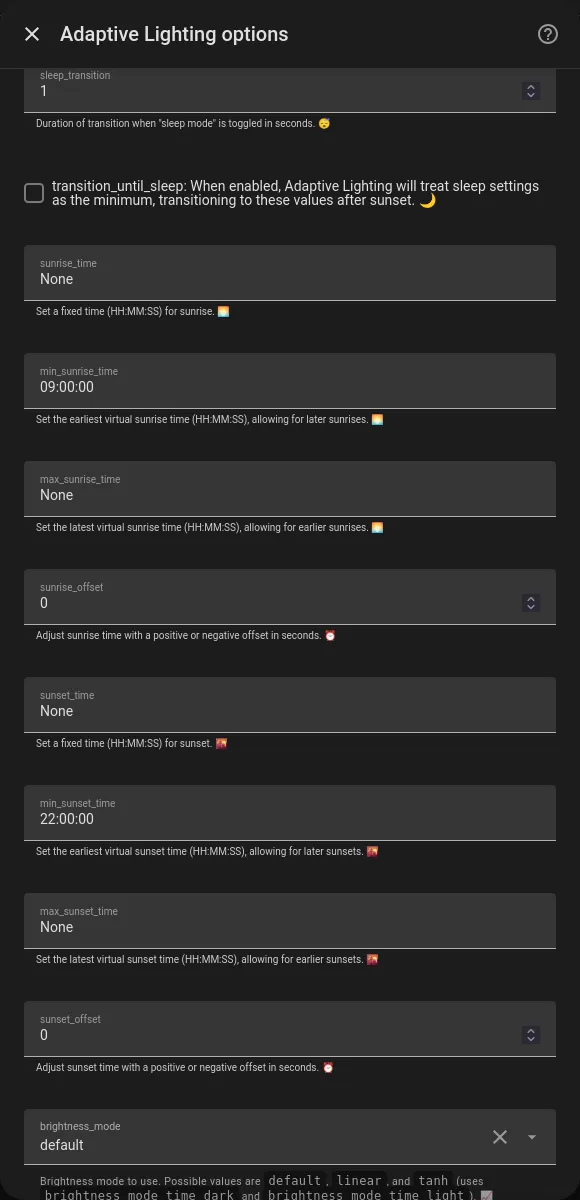
For Home Assistant users, there is a popular HACS integration called Adaptive Lighting.
By default, it follows sunrise and sunset.
That works reasonably well as a starting point.
Daily life, however, rarely follows astronomy perfectly.
I rarely begin my day before around 08:00 and sleeping before midnight is uncommon, so I configured adaptive lighting differently. In my own setup, minimum sunrise starts around 07:00 while sunset remains closer to 22:00, allowing lighting inside my home to follow my rhythm rather than the actual position of the sun.
Good automation should adapt to people.
People should not reorganize themselves around automation.
RGB Lighting Is Great. I Just Wouldn’t Start There.
Section titled “RGB Lighting Is Great. I Just Wouldn’t Start There.”Once comfort is handled properly, color becomes much more interesting.
This is where RGBWW lights begin making sense because the additional warm white LEDs allow lights to behave both as ambiance lights and practical everyday lighting.
Personally, I think RGB lighting works best as secondary lighting rather than primary lighting:
- Behind/inside shelves
- Lamps
- Corners
- TV backlighting
- Mood lighting
For main lighting, I strongly prefer tunable white bulbs combined with adaptive lighting.
For ambiance, RGBWW lights become much more interesting.
Smart Plugs: The Cheapest Way to Make Dumb Lamps Slightly Smarter
Section titled “Smart Plugs: The Cheapest Way to Make Dumb Lamps Slightly Smarter”Not every light in a home needs a smart bulb.
Floor lamps, bedside lamps, decorative lamps, or ambient lighting can often become surprisingly useful simply by connecting them to a smart plug.
I do not usually build lighting setups around smart plugs.
But when existing lamps are involved, they are practical and inexpensive (like this Thread Grillplats Plug with power monitoring by Ikea).
Sometimes simple wins.
Smart Lighting Is Only Half the Story Because Control Matters Just As Much
Section titled “Smart Lighting Is Only Half the Story Because Control Matters Just As Much”Something I underestimated when starting with smart homes was how strongly the method of control influences everyday comfort.
Eventually someone needs to turn lights on.
Sometimes that person is you.
Sometimes a guest.
Sometimes it is 3 AM and negotiating with a voice assistant sounds exhausting.
The way lights are controlled often matters as much as the lights themselves.
Wireless Smart Switches Quietly Became One of My Favorite Upgrades
Section titled “Wireless Smart Switches Quietly Became One of My Favorite Upgrades”After experimenting with different approaches over the years, wireless smart switches have become one of the accessories I recommend most despite rarely appearing in flashy smart home videos.
Not because they look impressive.
Because they remove friction.
Battery-powered switches can be placed beside beds, near sofas, on desks, near entrances, or directly over existing wall switches.
That last option turns out to be surprisingly practical.
Instead of accidentally cutting power to smart bulbs using traditional switches, existing habits remain unchanged while smart bulbs continue receiving power.
Guests still instinctively reach toward familiar locations.
Lights still react instantly.
Nobody needs instructions.
Over time these tiny reductions in friction become one of the most valuable parts of a smart home.
Wired Smart Switches Look Elegant Until Costs Enter the Conversation
Section titled “Wired Smart Switches Look Elegant Until Costs Enter the Conversation”At some point many people discover wired smart switches and think:
This looks cleaner.
Visually, that is often true.
In Japan, Panasonic Advance Series switches are interesting because some models support Echonet Lite and integrate with Home Assistant.
The problem is that wired smart switches frequently introduce two costs simultaneously:
- Hardware cost (Panasonic Advance Series switches are many times more expensive than what you can find abroad)
- Electrician cost
The double combo.
Then another issue appears.
Most wired smart switches physically cut power to bulbs.
Which sounds reasonable until smart bulbs enter the picture.
A smart bulb without electricity becomes… simply an expensive ordinary bulb.
Adaptive lighting stops.
Your IoT mesh network stops.
Automations stop.
Remote control stops.
Color control stops.
Traditional wired switches and smart bulbs become awkward roommates.
Relays Are Clever Devices Full of Tradeoffs
Section titled “Relays Are Clever Devices Full of Tradeoffs”Relays are small modules installed behind existing switches to add smart functionality while keeping the original wall hardware and visual style. On paper, they look like the best of both worlds: keep familiar switches, add automation, and avoid redesigning the room.
The tradeoff appears with how many relays work by default. Classic relay behavior still cuts electricity to the bulb, so smart bulbs immediately lose what made them smart in the first place. Products like SwitchBot Relay Switch 1 make this approach increasingly interesting in Japan, but availability is still limited and installation requires an electrician.
Some relays offer a virtual-switch mode instead. In that setup, the wall switch no longer cuts power directly; it sends an event to Home Assistant, and Home Assistant tells the smart bulb what to do:
Wall switch → Home Assistant → smart bulb reacts
Technically, this is elegant because power remains available, adaptive lighting keeps running, and bulbs stay online. But this is also where I become cautious: now a basic wall switch depends on your smart home, and if it fails, controlling lights is not possible.
That conflicts with one of my own principles:
Smart homes should preserve manual control whenever possible.
Eventually something breaks, and when it does, I still want switches behaving like switches.
Tiny Robot Finger Option
Section titled “Tiny Robot Finger Option”Products like the SwitchBot Bot solve the problem differently.
Their purpose is wonderfully absurd: Physically press your existing switch. No rewiring. No electrician.
Would I call it beautiful?
Not really.
Attaching a small robot to a wall switch is difficult to describe as aesthetic.
Would I call it useful?
Absolutely.
Especially for rentals.
Sometimes practicality wins.
Dimmers Deserve More Attention Than They Receive
Section titled “Dimmers Deserve More Attention Than They Receive”People often focus heavily on colors while forgetting brightness entirely.
Yet even warm lighting can feel aggressive at full intensity late at night.
Dimmer switches and dimmer relays allow lighting to become softer as evenings progress, and a room illuminated at 20% brightness frequently feels dramatically calmer than one illuminated at full power despite using identical bulbs.
Compatibility matters though.
Not every bulb supports dimming correctly and availability in Japan is limited.
Protocols: ZigBee, Thread, Wi-Fi… and Why the Invisible Part Matters
Section titled “Protocols: ZigBee, Thread, Wi-Fi… and Why the Invisible Part Matters”Eventually another question appears:
Why does this bulb require a hub while this other one connects directly to Wi-Fi?
Behind the scenes, every smart device still needs a way to communicate.
ZigBee
Section titled “ZigBee”ZigBee remains one of my preferred options because it combines several characteristics that matter in everyday use:
- Low power consumption
- Local control
- Mesh networking
Mesh networking means devices help relay signals for each other.
In practice, adding more powered ZigBee devices often strengthens coverage.
Another advantage is locality.
If your internet disappears, ZigBee lights connected through Home Assistant generally continue functioning.
Personally, I like my lighting not depending on whether a company server somewhere is having a bad day.
Thread
Section titled “Thread”Thread follows surprisingly similar ideas.
It is also:
- Low power
- Local
- Mesh based
Thread is becoming increasingly important through Matter.
The ecosystem is improving quickly, although ZigBee still feels more mature in many categories today.
Wi-Fi devices are attractive because setup is usually simple.
Buy bulb.
Open app.
Connect.
Done.
The downside appears later.
Wi-Fi devices increase load on networks, and many rely heavily on cloud services.
Convenience and independence often sit on opposite sides of a balance.
What I Would Actually Recommend Today
Section titled “What I Would Actually Recommend Today”After experimenting with different bulbs, switches, automations, and spending an unreasonable amount of time tweaking color temperatures most visitors would probably never consciously notice, the setup I would recommend today has become surprisingly simple.
For main lighting, I would choose:
Tunable white bulbs + adaptive lighting (The Kajplats series from IKEA is priced competitively)
For ambiance:
RGBWW lights (Once again, IKEA has some interesting options)
For entertainment spaces:
Philips Hue Sync + surrounding lighting
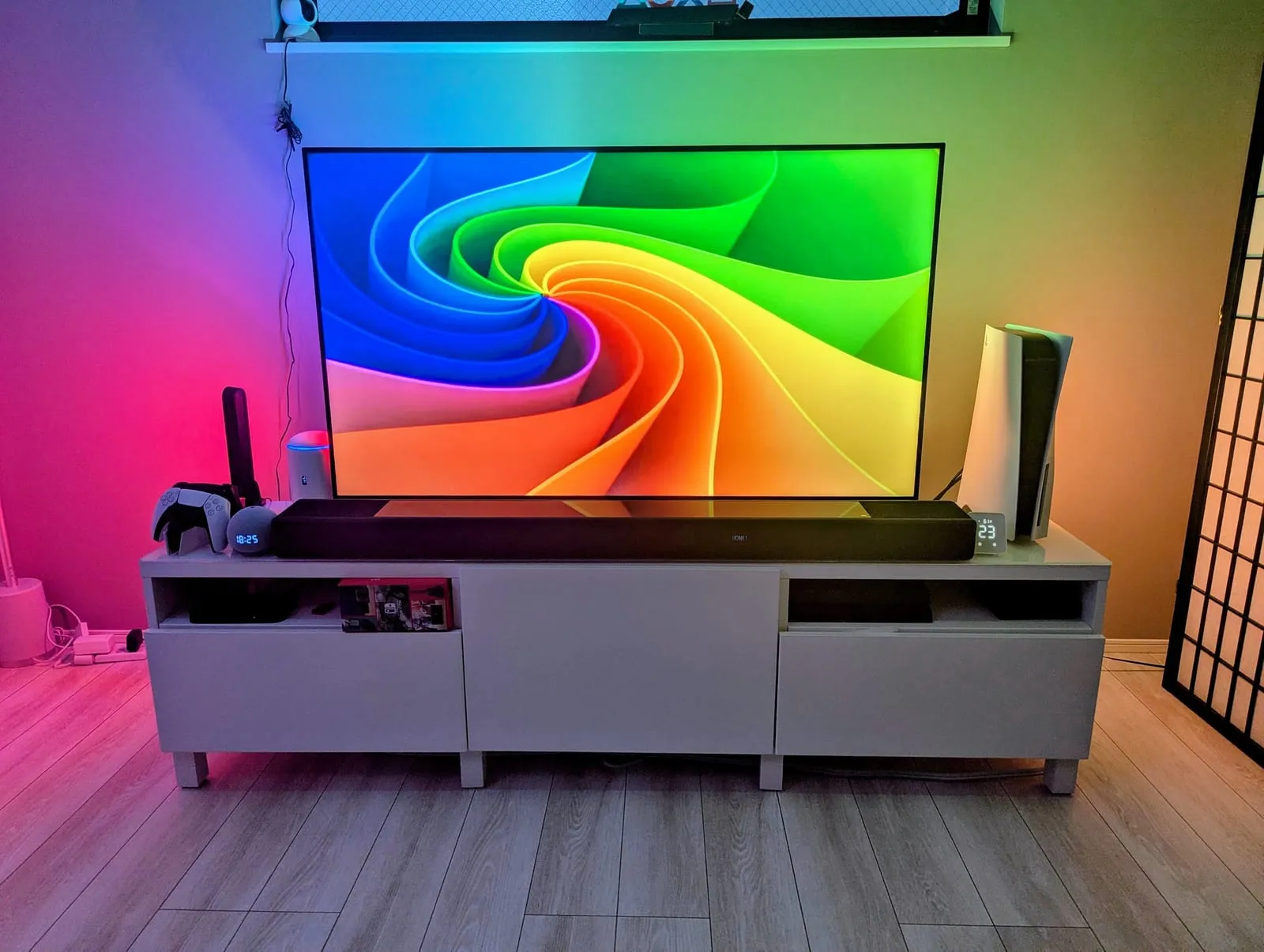
My own setup uses a LED strip behind the television, additional lighting on the side of the TV, above curtains and shelves, and also smart bulbs for the ceiling.
I would not describe any of this as essential.
I lived perfectly well before installing it.
At the same time, after becoming accustomed to environmental lighting reacting to movies or games, returning to completely static rooms can feel strangely flat.
For control:
Wireless switches everywhere your hands naturally reach.
Near beds.
Near sofas.
Near existing switches.
I prefer 4 buttons switches like this Zigbee model from Hue or cheaper like the ZigBeeStyrbar switch by Ikea. You also have cheaper 2 buttons switches like this Thread Bilresa switch by Ikea.
Convenience compounds over time.
Tiny reductions in friction become habits.
Habits quietly become comfort.
Final Thoughts
Section titled “Final Thoughts”Good smart lighting rarely looks impressive in product photos because its impact appears slowly.
You notice it when mornings become gentler.
When late-night trips stop blinding you.
When evenings become softer without requiring conscious effort.
Eventually the technology fades into the background.
And that may be the best compliment a smart home can receive.